
Best Japanese Microbrand Watches: 10 Brands Worth Knowing
If you know Japanese watches mainly through Seiko, Citizen, Casio, or Orient, you're missing another side of the country’s watch scene. Microbrand watches in Japan come from smaller companies and independent makers that can take a much narrower, more personal approach to watch design. Some produce only a handful of models, while others build around a particular style, movement, or traditional craft. The result is a category filled with unusual designs, limited-production watches, Japanese craftsmanship, and plenty of mechanical character.
What Are Japanese Microbrand Watches?
There is no official production number that turns a watch company into a “microbrand.” The term generally refers to a small, independent watch business that produces watches in limited quantities, often works with specialist suppliers, and sells directly or through a relatively small retail network.
That description fits a growing number of Japanese microbrand watches, although the category is broader than it first appears. A brand may design its watches in Japan and have them assembled there, while sourcing particular components elsewhere. Another may use a Japanese movement but manufacture the case or complete the watch overseas. In other words, “Japanese brand,” “Japanese movement,” and “Made in Japan” should not be treated as interchangeable terms. Current industry coverage makes the same distinction.
This is also where smaller makers differ from Seiko, Citizen, and Orient. Those companies operate at a completely different scale, with extensive production capabilities, large collections, international distribution, and established service networks.
For Japanese microbrand watch brands, being small can actually be part of the appeal. A founder can concentrate on one case shape, a particular dial style, or a very specific idea instead of designing for the widest possible audience.
Why Are Japanese Microbrand Watches Popular?
The first thing you notice about many small brands is that they are willing to take chances.
A microbrand does not necessarily have to design a watch that will appeal to millions of buyers. That freedom can show up in the details: a 35mm vintage-style case, a strange dial layout, bold colours, retro-futuristic displays, or a mechanical watch with proportions inspired by another era. WatchTime’s recent look at Japanese independents, for example, highlights everything from Kyoto-made vintage designs to colourful urban watches and unconventional digital pieces.
Small-batch production adds to the attraction. When a reference is made in limited numbers, owning one feels a little different from buying a mass-market model. Collectors often enjoy that sense of discovery as much as the watch itself.
There is also plenty here for people who enjoy mechanical watchmaking. Japanese mechanical watches can range from straightforward automatic models using familiar Miyota or TMI calibres to much more elaborate independent creations.
That variety is a major reason Japanese microbrand watches have found an audience among collectors. You are not simply buying a watch with a Japanese name on the dial; you are often buying into a particular designer's taste or a small company's story.
What Are the Best Japanese Microbrand Watch Brands?

Rather than putting these brands into a rigid “number one, number two” ranking, it makes more sense to look at what makes each one interesting. The Japanese microbrand scene covers a surprisingly wide range of prices and styles.
KUOE Kyoto
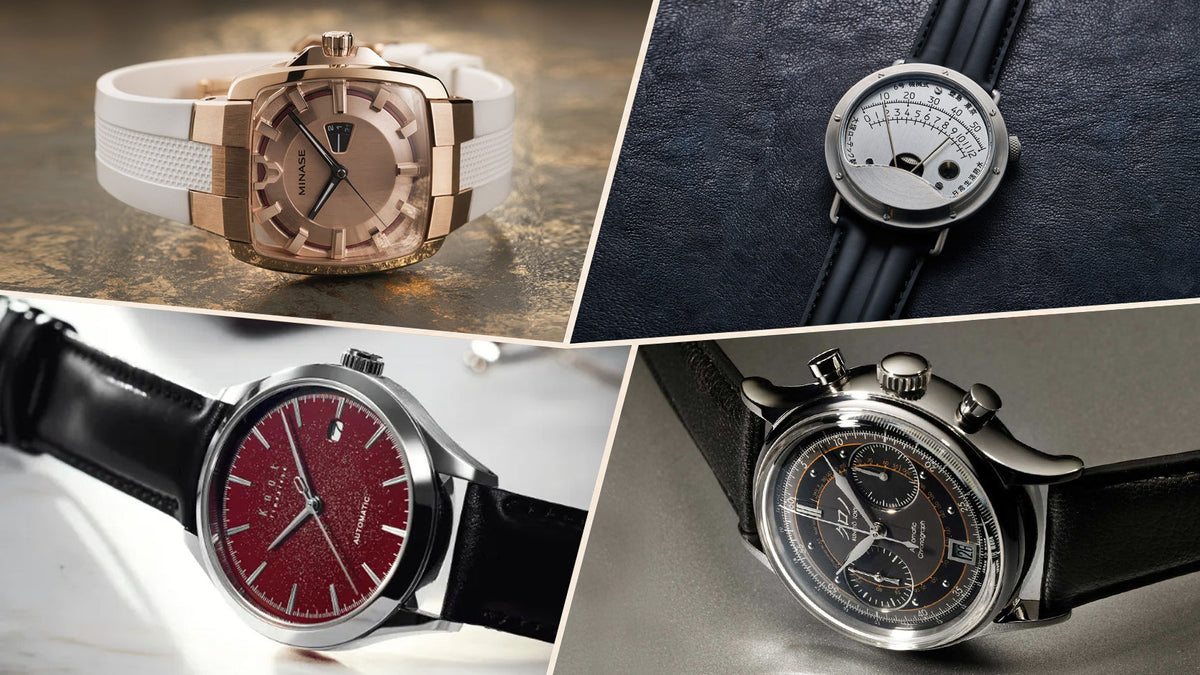
KUOE Kyoto is a natural starting point for buyers who like old-school watch proportions. Established in Kyoto in 2020, KUOE focuses on classic, vintage-inspired designs and assembles its watches in its Kyoto workshop. Its automatic range includes models using Japanese TMI movements.
Kurono Tokyo
Kurono Tokyo sits closer to the collector end of the spectrum. The brand grew out of independent watchmaker Hajime Asaoka’s design philosophy and is known for carefully considered proportions, typography, colours, and Art Deco influences. Kurono was created to make that design language available to a broader group of enthusiasts than Asaoka’s highly limited atelier work.
Knot
Knot takes a different route, with a broad catalogue and an emphasis on Japanese craftsmanship. Its mechanical and automatic watches include models featuring movements such as the Miyota 9015 and Seiko NE88, while its Japan Concept pieces bring traditional decorative techniques into contemporary watch designs.
MINASE
MINASE is a more specialized proposition. The brand grew from a Japanese precision-tool and watch-case manufacturing background, and its watches are particularly notable for intricate case construction and finishing.
Otsuka Lotec
Otsuka Lotec is for the buyer who wants something genuinely unconventional. It offers the best affordable Japanese microbrand watches. These watches feature jumping-hour, retrograde, and other display systems, with in-house modules paired with Japanese automatic movements. Several current models are made in Japan.
These brands show why the phrase Japanese independent watch brands covers far more than one particular style of watch.
Are Japanese Microbrand Watches Worth Buying?
For the right buyer, yes—but the reason to buy one should go beyond the words “limited edition” or “Japanese.”
The strongest argument is individuality. Affordable Japanese microbrand watches can give you a design that feels considerably less familiar than the usual choices from major manufacturers. Depending on the model, you may also get a Japanese automatic movement, sapphire crystal, a well-finished steel case, or a small production run without moving into traditional luxury-watch pricing.
There are trade-offs. A small company cannot always offer the same international servicing network as Seiko, Citizen, or Orient. If a watch needs attention, you may have to deal directly with the brand and possibly ship the watch overseas. Check parts availability for the same reason.
Price matters, too. A microbrand may spend more on a small production run, specialized finishing, or an unusual dial, so two watches with similar movements can have very different prices.
And then there is resale. Some Japanese microbrand watches develop enthusiastic followings; others remain niche. Limited production alone doesn't guarantee a watch will become more valuable.

What Should You Check Before Buying a Japanese Microbrand Watch?
Start with the movement. Don't stop at “automatic” in the specifications. Find the exact calibre, manufacturer, power reserve, accuracy range, and servicing requirements. A familiar movement can be a practical advantage when the watch is several years old.
Next, look at the physical watch. Is the case stainless steel or titanium? Is the crystal sapphire or mineral? How is the bracelet finished? What does the stated water resistance actually allow you to do?
For Japanese automatic microbrand watches, these details matter because two watches using broadly similar movements can have very different levels of case construction and finishing.
Warranty terms are just as important. Check how long the warranty lasts, what it covers, where repairs are handled, and who pays for shipping. If the company is based in Japan and you are buying from overseas, find out how an international warranty claim works before placing the order.
Also check the return policy, replacement-parts situation, seller authenticity, and the brand's track record. Look for clear information about where the watch is designed, manufactured, and assembled.
Finally, do not confuse a Japanese movement with a completely Japanese-made watch. That distinction is particularly useful when comparing affordable Japanese microbrand watches with one another.
FAQs About Japanese Microbrand Watches
1. What Are the Best Japanese Microbrand Watches to Buy?
2. Are Japanese Microbrand Watches Worth Buying?
3. Which Japanese Microbrands Offer the Best Value?
4. What Should You Look for When Buying a Japanese Microbrand Watch?
5. Are Japanese Microbrand Watches Good Quality?
6. Which Japanese Microbrands Make the Best Automatic Watches?
7. Do Japanese Microbrand Watches Hold Their Value?
8. Where Can You Buy Authentic Japanese Microbrand Watches?

Leave a comment
This site is protected by hCaptcha and the hCaptcha Privacy Policy and Terms of Service apply.