
Hands-On: Vario 1945 D12 Bronze Field Watch – Where History Meets Patina
Eighty years ago, twelve Swiss and British watch manufacturers received an unusual order from the British Ministry of Defence. The requirement was strict: a black dial with Arabic numerals, a railroad-style minute track, luminous hands and indices, a small seconds at 6 o'clock, a shock and water resistant case, and a proven movement. No signature style, no house character; just pure, legible function for the battlefield. The resulting collection became known among collectors as the Dirty Dozen, and its influence on field watch design has never truly faded.

Vario, the Singapore-based microbrand founded in 2016 by designer Ivan and his partner Judy, has been working through military watch history with impressive dedication, first with a WWI trench watch interpretation, now with their take on the Dirty Dozen brief. The 1945 D12 Bronze Field Watch is their most material-forward release yet. And the first 200 pieces carry something worth turning the watch over for: an engraved case back reading 80 Years · 1945–2025, marking the anniversary of the war's end. Mine is one of them.
First Impressions and the Bronze Question

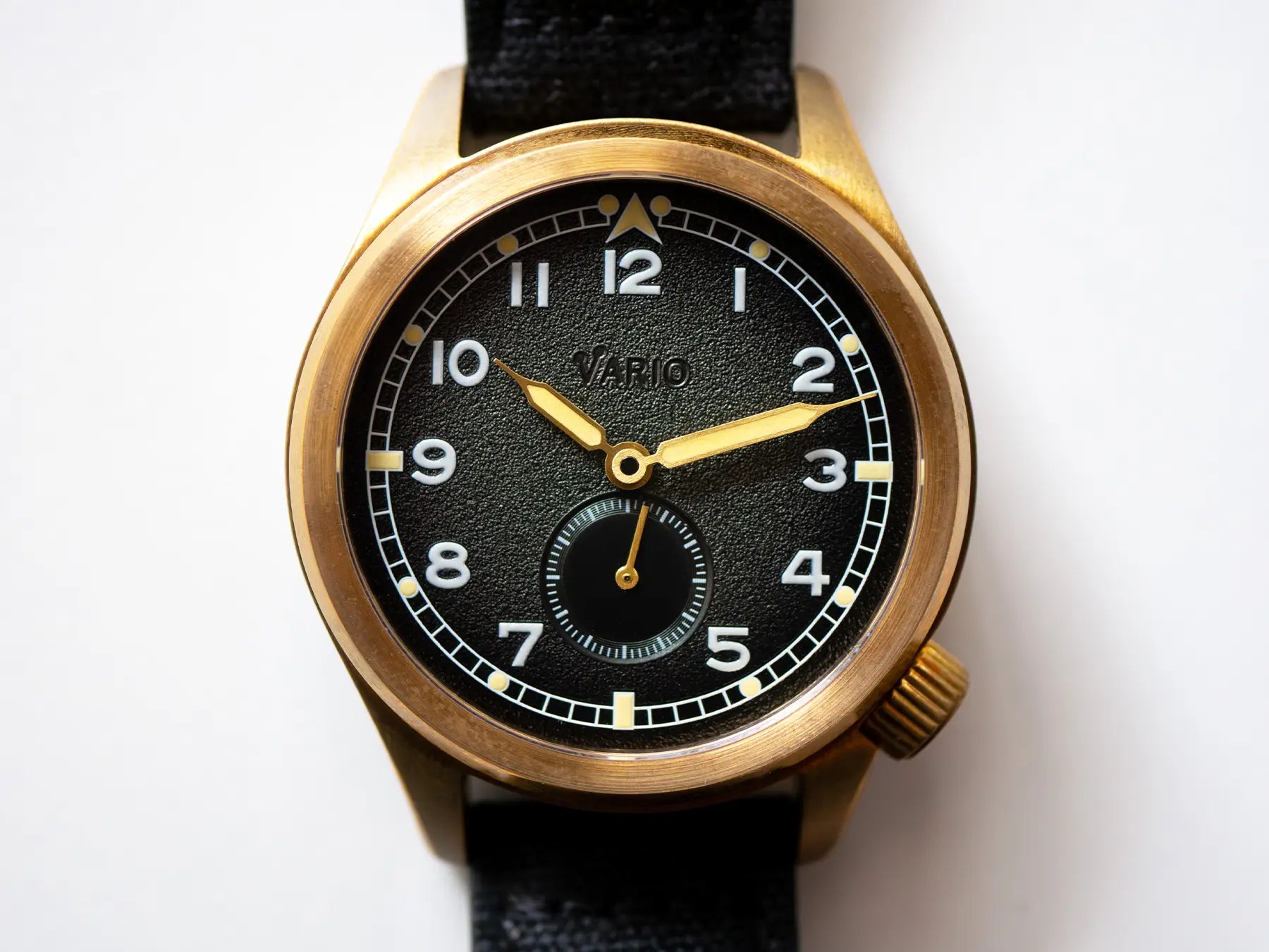
The moment you pick up the 1945 D12 Bronze, it announces itself differently from a steel watch. There is a warmth and density to the Qsn6.5-0.1 bronze alloy, not heavy, but distinctly present, and the brushed gold-amber surface catches light in a way that stainless steel simply cannot replicate. The crown is positioned at 4 o'clock rather than the traditional 3, a detail borrowed from Vario's earlier Trench Watch that does more than it seems: on a small case it prevents the crown from pressing against the back of the hand during wear, and on a 37mm watch that really matters.
The waxed canvas strap (made from recycled material) is another characterful touch. Dark and matte, it creates a deliberate contrast against the glowing bronze of the case and the gilt-toned hands, with a texture that looks immediately broken-in without feeling rough on the wrist.
The Case — 37mm, But Don't Let That Worry You

At 37mm in diameter, 10.5mm thick, and 45mm lug-to-lug, the 1945 D12 Bronze is a genuinely compact watch. On my 17.5 cm (6.9") wrist it sits beautifully, modest without disappearing, the pronounced bezel and dial proportions keeping it visually present despite the restrained dimensions. If you are used to 40mm+ tool watches, there will be an adjustment period. Give it a day, and it starts to feel exactly right for what it is. The case finishing is carefully considered.
The top surfaces of the case and lugs are brushed, the bezel carries a circular brushed finish on the flat face, and the sides of the bezel are polished, a subtle contrast that lifts the whole profile. The sapphire crystal sits flush and clean with an inner anti-reflective coating; there is no dome, no distortion, just a clean window onto a very well-composed dial.
The Dial — A Dirty Dozen Brief, Faithfully Interpreted
Open the original Dirty Dozen specification and you could almost be reading a description of this dial. Black ground. Arabic numerals. Railroad-style minute track running the full circumference. Small seconds sub-dial at 6 o'clock. Luminous indices and hands. Vario has followed the brief carefully — and then done something interesting with the texture.

The dial surface is not smooth. It has a fine, sandy matte texture that gives it an almost three-dimensional quality under close inspection, lending the watch a slightly raw, workshop character that feels entirely appropriate for a field watch homage. The numerals are applied in white with a generous lume application. At 12 o'clock, a broad arrow, the British military ownership mark, takes the place of a traditional index, itself a historically accurate detail that Vario has thoughtfully reinterpreted rather than copied directly.
The gold-toned hands (matching the bronze case) are slender and pointed, classical in form, and large enough to read quickly. The small seconds sub-dial at 6 o'clock is a sunken matte black disc ringed with a white minute scale; it reads cleanly and adds the right amount of visual weight to the lower half of the dial without dominating.
The Lume — Two Colors, One Good Idea

This is where Vario made a decision that looks unusual in photographs but makes complete practical sense. The hands carry C3 SuperLumiNova; the bright green-charging variety, while the indices and numerals use BGW9, the cooler blue-toned lume. In the dark, the result is a two-color display: green hands, blue numerals. Once charged, the C3 on the hands glows intensely, making the hour and minute position immediately readable even before your eyes adjust. The blue BGW9 on the indices provides orientation and framing. It works. In practice, you read the green hands first and the blue dial second, which is exactly the hierarchy you want.
The Movement
Inside the 37mm bronze case sits the Miyota 82S5 automatic, a gilt-finished movement with Côtes de Genève decoration, hand-winding, hacking seconds, 21 jewels, running at 21,600 vph (3Hz) with a power reserve of over 40 hours. Vario offers the option of a sapphire exhibition caseback for an additional cost, which makes sense here: the gilt decoration on the 82S5 is genuinely attractive through glass, and the movement's finishing is a small but meaningful upgrade over the standard 82-series that you might not expect at this price point.
The first 200 bronze pieces instead carry the commemorative steel caseback engraved with 80 YEARS · 1945–2025, and honestly, that is the more compelling option for this particular watch. It connects the object directly to its historical reason for existing.
Bronze Patina — The Living Case
Bronze is the most patient material in watchmaking. Over weeks and months, the Qsn6.5-0.1 alloy of the 1945 D12 will absorb the wearer's environment, sweat, sunlight, humidity, the particular chemistry of skin, and develop a patina that is uniquely theirs. Dark patches will form on contact points, the brushed surfaces will shift from bright gold to deeper amber tones, and eventually the whole watch will carry a visible record of where it has been. Vario is clear that this process can always be reversed, a gentle polish restores the original lustre, but most owners will choose to let it run.
It is one of the genuine arguments for bronze over steel at any price point. A bronze watch is alive in a way a steel watch is not.
Conclusion
The Vario 1945 D12 Bronze Field Watch achieves something that homage watches rarely manage cleanly: it respects its source material without being enslaved by it. The brief is followed, black dial, railroad track, small seconds, luminous hands, but the textured dial surface, the gilt movement, the 4 o'clock crown position, and above all the bronze case give the watch its own identity. At $428 USD it is exceptional value for what you receive: a sapphire-crystalled, 100m water resistant, hacking automatic field watch with a legitimately interesting back-story and a case material that will only grow more individual with time.
Specifications
- Movement: Miyota 82S5 automatic, gilt finish, Côtes de Genève, hand-winding, hacking seconds, 21 jewels, 21,600 vph, 40+ hours power reserve
- Case: Qsn6.5-0.1 bronze, 37mm diameter, 10.5mm thick, 45mm lug-to-lug
- Lug width: 18mm
- Crystal: Sapphire with inner anti-reflective coating
- Water resistance: 100m / 10 ATM
- Crown: Screw-down, positioned at 4 o'clock
- Caseback: 316L stainless steel (first 200: engraved 80 Years 1945–2025)
- Lume: C3 SuperLumiNova (hands) / BGW9 (indices)
- Strap: Waxed canvas from recycled material
- Price: From $473 USD (steel) / $555 USD (bronze)

Leave a comment
This site is protected by hCaptcha and the hCaptcha Privacy Policy and Terms of Service apply.